Primary Applications
- Thermal-shock screening of electronic components, connectors, soldered assemblies and material joints.
- Evaluation of expansion mismatch, cracking, seal degradation and intermittent electrical faults.
- Development qualification using repeated hot/cold exposure and defined dwell times.
- Comparison of design changes under an agreed specimen load and temperature-shock profile.
Product Features
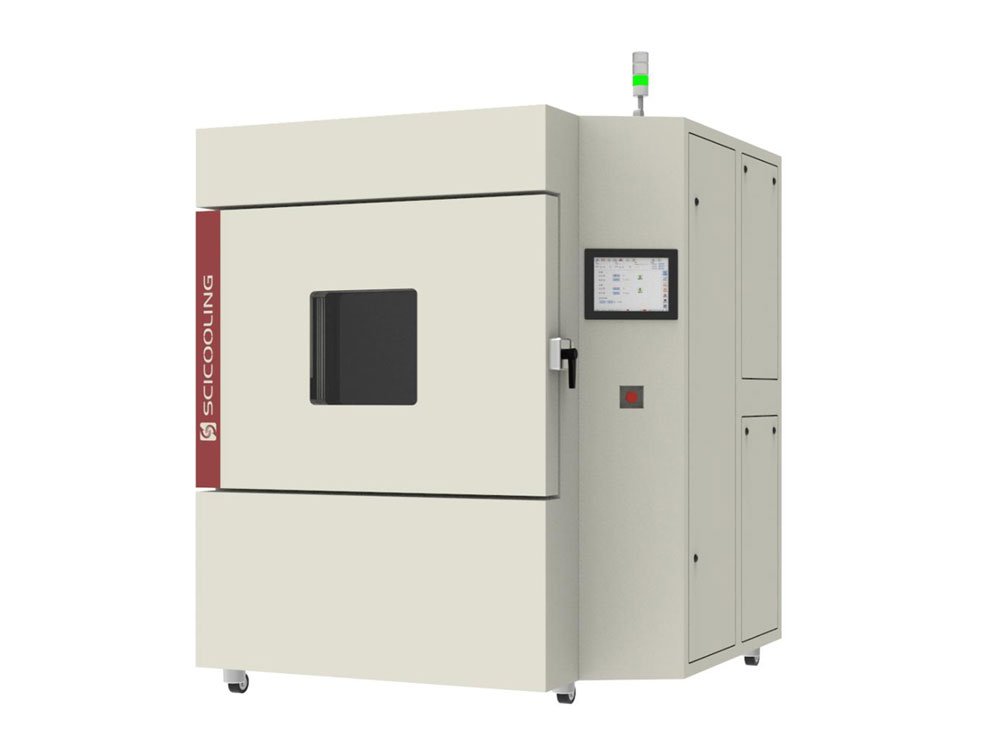
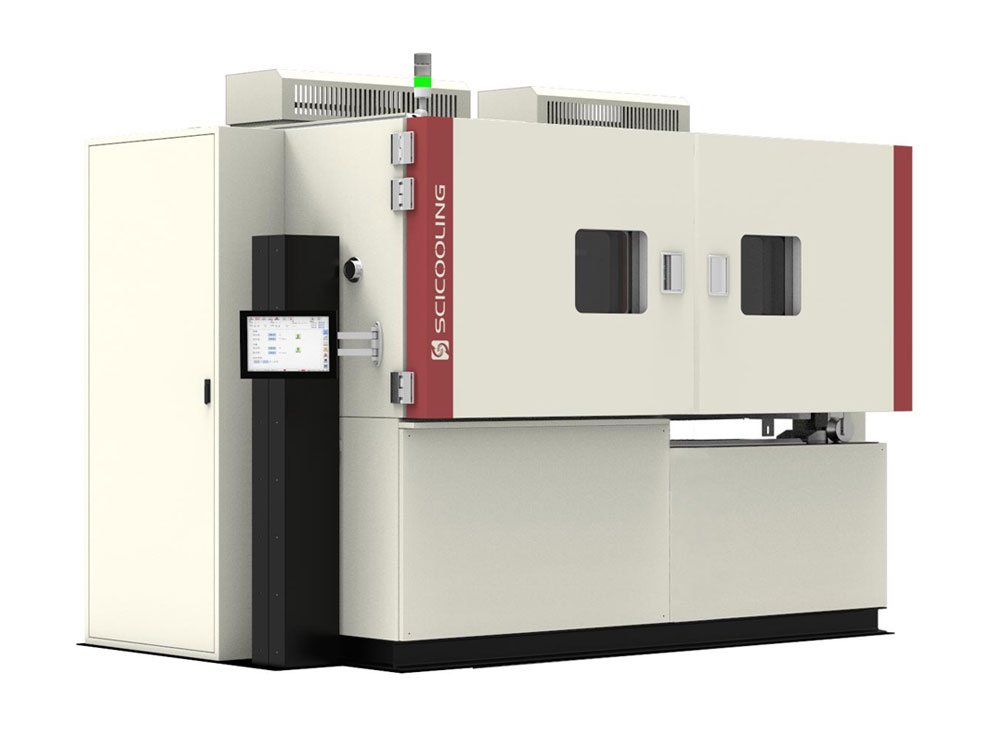
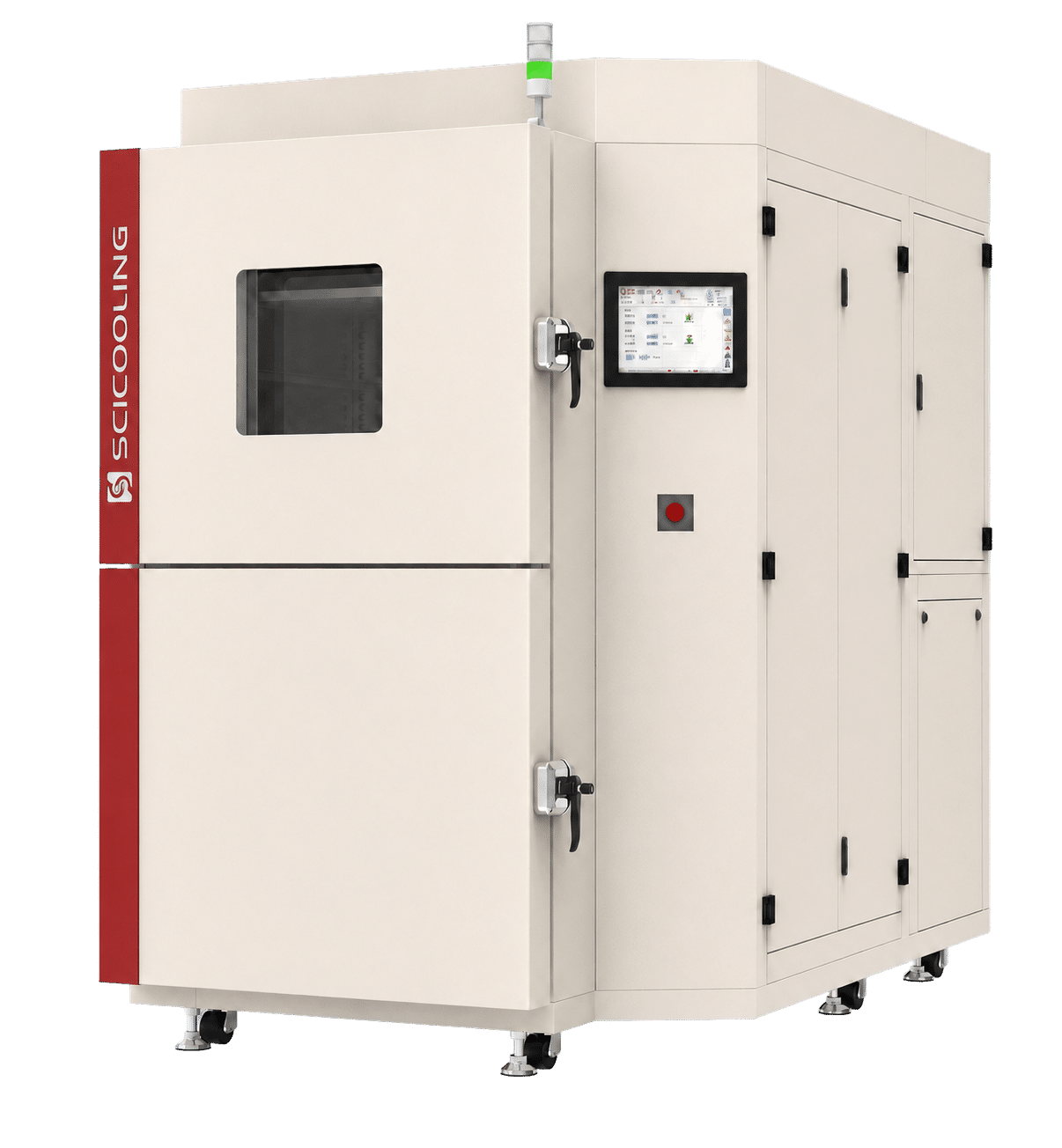
- Two-zone basket-transfer design moves specimens between separately conditioned hot and cold zones.
- Hot-zone operating range: +80°C to +180°C; cold-zone operating range: −70°C to +150°C.
- Reference shock profile: +150°C / −55°C, with 30-minute exposures and model-specific aluminium loads.
- Basket-transfer time and loaded recovery performance are stated separately for each model.
- Vertical basket-transfer arrangement, with 49, 100 and 210 L basket models listed below.
Applicable Test Standards
Select the exposure method, then confirm the test profile and specimen load for your application.
Rapid temperature changes using air or a suitable gas; transfer or changeover time and loaded recovery must match the test profile.
Define in your protocol
- Exposure temperatures, dwell time and cycle count
- Transfer/changeover time and specimen operating state
Confirm for this chamber
- Loaded recovery and specimen stabilization
- Separate zone operating limits from the validated shock profile
Semiconductor device temperature cycling.
Define in your protocol
- Selected test condition, cycle count and dwell periods
- Electrical measurements and device acceptance criteria
Confirm for this chamber
- Usable working zone and actual specimen temperature
- Fixtures, loading arrangement and transition performance
Atmospheric temperature-shock profiles tailored to the specimen and intended environment.
Define in your protocol
- Applicable revision, procedure and tailored severity
- Operational state, exposure sequence and functional checks
Confirm for this chamber
- Achievable transition and loaded temperature response
- Measurement points, recovery and configuration review
Related Industry Requirements
JESD22 / AEC-Q100
Device-specific methods and controlled revision
Select the applicable controlled method, exposure medium, specimen measurements and acceptance criteria. Electrical bias and complete device qualification require the specified additional apparatus and procedures.
MIL-STD-810H + Change 1
Environmentally tailored profiles
Select the method and severities for the intended service environment. Confirm the applicable revision, specimen operating state, monitoring locations and loaded test performance.
ISO 16750-4:2023
Climatic loads for vehicle electronics
Select the climatic program for the mounting location and intended operating state. Confirm specimen supply, heat dissipation, tolerances and functional checks.
Zone operating limits are different from the validated loaded shock profile. Confirm specimen temperature, transfer time and recovery criteria for the intended method. The applicable edition, test severity, load and monitoring requirements are confirmed for the ordered configuration. Standard references do not imply complete product certification.
Technical Specifications
| Current standard specifications | ||||
|---|---|---|---|---|
| Model / platform | CTS-DD7505CV-AW/BW | CTS-DD7510CV-AW/BW | CTS-DD7521CV-AW/BW | |
| Nominal workspace | L | 49 | 100 | 210 |
| Interior dimensions | W × H × D (mm) | 400 × 350 × 350 | 500 × 400 × 500 | 650 × 500 × 650 |
| Exterior dimensions | W × H × D (mm) | 1060 × 1950 × 1950 | 1210 × 1980 × 2090 | 1360 × 2180 × 2300 |
| Observation window | W × H (mm) | 250 × 250 | 300 × 300 | 350 × 350 |
| Cable port diameter | mm | 50 | 50 | 100 |
| Shelf load | kg/shelf | 15 | 15 | 25 |
| Unit weight | kg | 1000 | 1200 | 1500 |
| Cold-zone operating range | °C | −70°C to +150°C | ||
| Hot-zone operating range | °C | +80°C to +180°C | ||
| Temperature fluctuation | °C | ≤±0.5°C; empty, steady state | ||
| Temperature uniformity | °C | ≤2.0°C; empty, steady state | ||
| Temperature deviation | °C | ≤±2.0°C; empty, steady state | ||
| Shock load at +150 / −55°C | kg aluminium | 5 | 10 | 20 |
| Shock load at +150 / −65°C | kg aluminium | 1 | 3 | 8 |
| Temperature recovery | 5 min; 30 min dwell in each zone; air-outlet measurement | |||
| Basket transfer / air-damper changeover | s | ≤5 | ||
| Power supply | AC 380 V ±10%, 50 Hz ±1 Hz, 3L+N+PE | |||
| Installed power | kW | 19.7 | 23 | 53 |
| Supply circuit breaker | A | 50 | 63 | 125 |
| Cooling-water requirement | 3/1.6/1 t/h at 29 / 24 / 13°C, water-cooled configuration | 4/2/1.2 t/h at 29 / 24 / 13°C, water-cooled configuration | 9/4.5/4 t/h at 29 / 24 / 13°C, water-cooled configuration | |
| Cooling-water connection | DN25 | DN32 | DN40 | |
| Temperature sensor | Type-T thermocouple | |||
| Communication interfaces | One RS232 interface; one RJ45 Ethernet interface; one USB data interface; RS485 optional | |||
Reference recovery uses +150°C / −55°C, 30-minute exposures and the model-specific non-self-heating aluminium load. Hot-zone and cold-zone limits are conditioning ranges; they are distinct from the reference shock profile.
Recovery is measured at the air outlet after 30-minute exposures at +150°C and −55°C / −65°C, using the corresponding aluminium loads in the table. Shelf capacity, shock load and zone operating range are separate specifications.
Construction and configuration
| Compressor | Imported-brand compressor |
|---|---|
| Refrigeration components | Sporlan, OLAB, Saginomiya, Danfoss, Emerson or equivalent specified components |
| Interior material | 304 stainless steel |
| Exterior material | Electrostatically powder-coated cold-rolled steel |
| Observation window configuration | One coated, heated, frost-resistant insulated-glass window with illumination |
| Heater | Grouped nickel-chromium heating elements with ceramic insulating supports |
| Controller | SCI TP-V3.0 controller: industrial host, PLC and proprietary control software |
| Touchscreen | 12-inch colour touchscreen |
| Safety protection | Earth-leakage, phase-sequence and overload protection; refrigeration overpressure / overheating protection; fan overload and heater overtemperature protection; specimen overtemperature protection; low-water and humidifier dry-heating protection |
| Standard accessories | Casters and levelling feet; one cable port with silicone plug; two specimen shelves; 5 m cable |
| Software and documentation options | Custom engineering, remote-control software, third-party calibration and certification reports |
| Accessory options | Insulated specimen shelves, custom fixtures, service tools and dry-air system |
| Installation environment | Ambient temperature 5–35°C; ambient humidity ≤85% RH. Provide ventilation, avoid vibration, electromagnetic interference, dust and corrosive substances. Reserve at least 1 m around enclosed sides and door width + 1 m in front. Drain within 5 m of the refrigeration unit, height ≤30 mm; Ø16 mm quick-connect drain. |