SCI

01 · CORE TECHNOLOGY

CORE CRYOGENIC TECHNOLOGY

From conventional cascade refrigeration to SCI single-compressor direct cooling.

core-cryogenic-comparison
Core cryogenic architecture · View full technical diagram ↗

1

compressor

−190°C

reference lower capability

Mixed refrigerant

direct-cooling cycle

One direct-cooling architecture across a wider range

Conventional ultra-low-temperature systems become progressively more complex as cascade stages are added. SCI applies mixed-refrigerant and liquid-nitrogen-production know-how to a single-compressor direct-cooling architecture, simplifying the refrigeration chain while extending low-temperature capability.

Simpler architecture. Fewer components. Wider ultra-low-temperature capability.

Why the architecture matters

  • Reduced mechanical complexity compared with multi-stage cascade systems
  • Compact equipment footprint and lower system weight
  • Fewer service points and lower maintenance requirements
  • High reliability from a shorter, more controllable refrigeration chain
  • Reference applications extending from 0°C to −190°C by configuration
single-stage-refrigeration
Single-stage refrigeration system · View full technical diagram ↗

−190°C

Reference ultra-low-temperature capability

Compact

Space-saving single-compressor architecture

Quiet

Lower-noise system configuration

Natural

Natural-refrigerant design pathway

Lightweight

Reduced system weight and component count

Efficient

Lower energy demand across the cycle

Reliable

Fewer components and failure points

Lower cost

Reduced maintenance and operating burden

Reference capability and architecture are based on company-supplied technical material. Final performance depends on chamber configuration, thermal load and operating conditions.

02 · CORE TECHNOLOGY

ENERGY EFFICIENCY & SYSTEM RELIABILITY

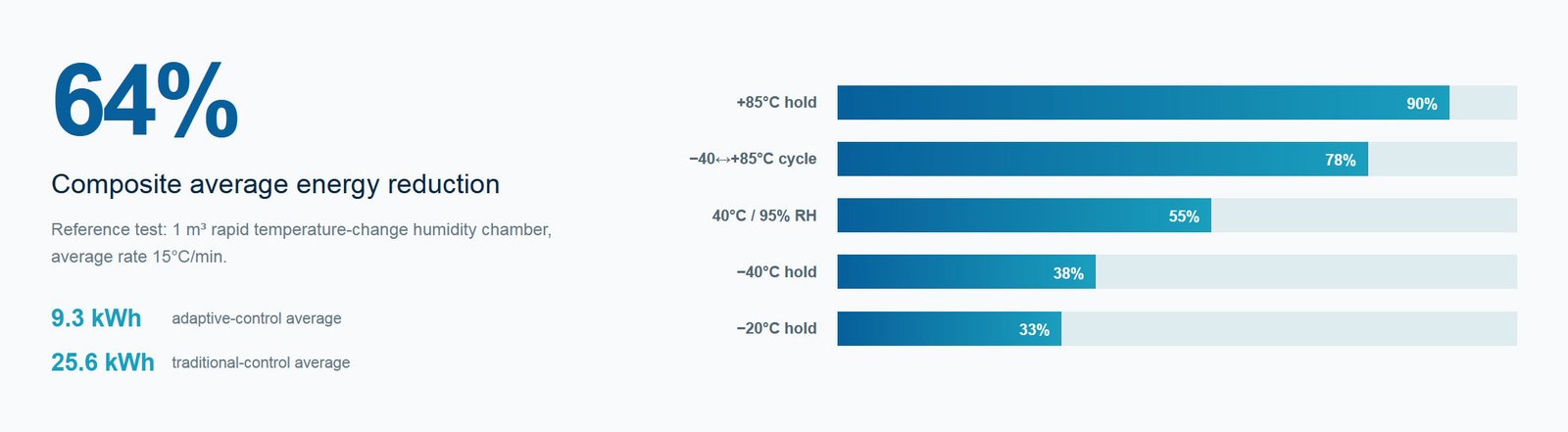
Intelligent PID control reduces thermal conflict while twelve refrigeration technologies protect stable operation.

Energy control & refrigeration reliability · View full technical diagram ↗

Cooling capacity matched to the actual demand

Traditional chambers may run the compressor at high output and use heating to offset excess cooling. SCI intelligent PID control evaluates the real thermal demand, starts the compressor only when cooling is required, and regulates output closer to the target curve.

No unnecessary heating during cooling. No unnecessary cooling during heating.

System-level reliability

  • Pressure, temperature and system-state parameters participate in control
  • Expansion, injection, subcooling and oil management are coordinated
  • Protective logic monitors overload, bypass, oil pressure and discharge conditions
  • Long-distance and multi-terminal installations are calculated as a system
01
High-efficiency heat-exchanger design
02
Pump-down technology
03
Suction-pressure balancing
04
Refrigerant distribution & injection
05
High-precision expansion-valve control
06
Variable-speed oil separation
07
Subcooling technology
08
Compressor intercooling
09
Compressor overload & bypass protection
10
Compressor oil-pressure protection
11
Suction/discharge temperature & pressure monitoring
12
Multi-terminal system parameter calculation

Company-supplied measured data from a 1 m³ rapid temperature-change humidity chamber at an average rate of 15°C/min. Results vary by configuration and load.

03 · CORE TECHNOLOGY

DIGITAL ENGINEERING & CONTROL

Simulation-led thermal design and purpose-built control software connect engineering decisions to test execution and diagnosis.

03A · SIMULATION-LED DESIGN

CFD reveals airflow and temperature risk before metal is cut.

Virtual verification resolves airflow, pressure loss and heat-transfer behavior early—reducing late-stage hardware changes and protecting chamber uniformity.

Chamber airflow & recirculation

Velocity & temperature field

Heat-exchanger behavior

Model & physical verification

MODEL SCOPE

  • Air velocity and return-path balance
  • Fan selection and pressure distribution
  • Evaporator and heater interaction
  • Temperature field and local hot/cold zones
  • Heat-exchanger behavior across the profile

ENGINEERING OUTCOME

7°C / 7% RH

Low temperature / low humidity

5°C / 90% RH

Low temperature / high humidity

35°C/min

Reference average ramp rate

20°C/min

Reference linear ramp rate

03B · CONTROL SOFTWARE & DATA

Operation, data and diagnostics inside one workflow.

Purpose-built control functions connect how environmental tests are created, executed, recorded, protected and linked to the laboratory.

Program control

Curves & test data

Remote diagnosis

Program and data continuity

The same controller workflow supports program definition, live execution, alarm handling and traceable records.
  • Constant-value and multi-step program operation
  • Real-time curves, historical curves and sampled data
  • Alarm records and extreme-temperature protection

Functions verified from the supplied SCI controller user guide.

Connectivity and diagnosis

Commissioning data establishes a baseline that supports remote diagnosis and faster service decisions throughout the equipment lifecycle.

  • User roles, permissions and parameter control
  • Serial and Ethernet communication
  • Remote diagnosis and customer protocol integration

Contact us to request information

Tell us about your test requirement and our engineering team will contact you.

ENGINEERING CONSULTATION

Turn your requirement into a buildable chamber specification.

Share the essentials. Our application engineers will help define a practical, reliable system.

Application and standards reviewPractical chamber configurationInitial response within 1 business day
SCI INSTRUMENTS CO.LTD
info@scicoolings.com
PROJECT ENQUIRY

Request Engineering Consultation

Tell us the essentials. Our application engineers will help complete the specification.