
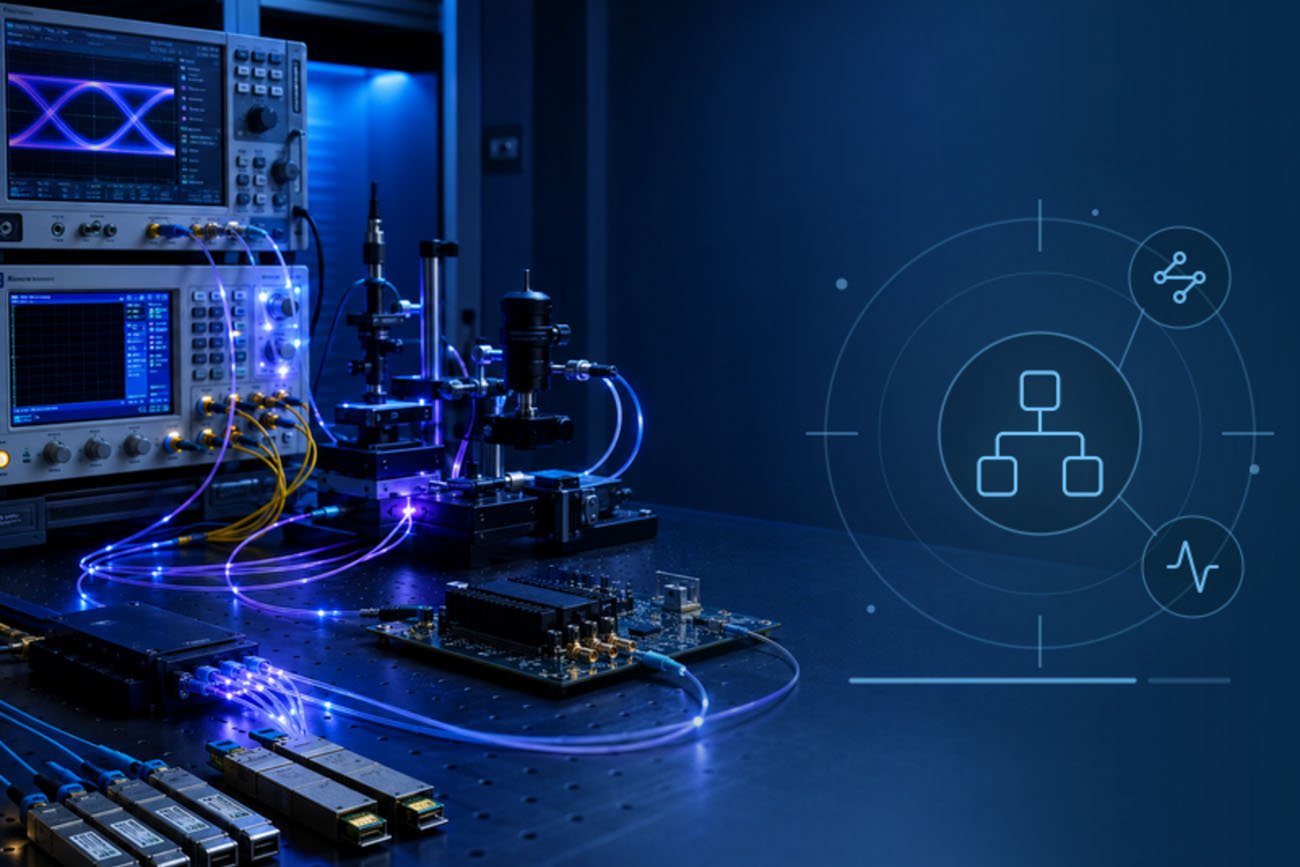
Optical transceivers and photonic components must maintain signal quality while lasers, detectors, drivers, optics, adhesives and fiber interfaces respond to temperature and moisture. Small dimensional changes can alter alignment, wavelength, insertion loss or coupling efficiency. Long operating hours in access networks and data infrastructure make gradual drift as important as immediate failure.
Environmental testing allows engineers to measure those changes under controlled conditions and compare designs before large-scale deployment.
Define the optical parameters that matter
The chamber profile should be linked to measurable performance. Depending on the device, monitor optical output power, receiver sensitivity, wavelength, extinction ratio, insertion loss, return loss, bit-error rate, supply current and module temperature. A simple functional check after testing may miss reversible drift that occurs only at temperature.
Time-align optical data with chamber conditions. This makes it possible to distinguish thermal stabilization from a true degradation trend.
Control cable and fiber routing
Fiber bend radius, connector stress and cable movement can affect the result. Use feedthroughs and fixtures that maintain stable routing across the temperature range. Avoid door seals that pinch fibers or create changing mechanical load.
For multiple channels, label both optical and electrical paths and verify baseline loss after installation. Fixture material should not introduce unrealistic thermal strain into the component under test.
Select the appropriate exposure
High- and low-temperature operation can reveal wavelength drift, power variation and control-loop limitations. Temperature cycling stresses package interfaces and optical alignment. Steady damp heat investigates long-duration moisture resistance, while cyclic humidity can evaluate condensation-related risks. Rapid temperature change may be useful for components that experience steep field transitions or for accelerated engineering evaluation.
The applied rate should be confirmed at the device, not inferred solely from chamber air. Dense trays and powered modules may change the thermal response.
Design for powered operation
Many optical devices need continuous bias, traffic or loopback testing. Calculate the heat load from all active samples and externalize sensitive instruments when possible. Provide enough electrical and optical feedthrough capacity without compromising chamber sealing.
If network equipment is tested as a complete assembly, airflow management becomes critical. The product’s internal fans can interact with chamber circulation, creating local conditions that differ from the nominal workspace.
Use recognized methods
Qualification programs may reference the IEC 61753 performance-standard family for fiber-optic interconnecting devices and passive components, IEC 60068 environmental methods, Telcordia requirements or customer-specific profiles. Confirm the exact document, category and edition before fixing the chamber sequence.
SCICOOLING supplies benchtop, temperature-humidity and rapid-change chambers with configurable ports and data integration. For optical testing, the best setup protects signal-path stability while delivering a documented environmental history to every sample.
Editorial note: Confirm the contractual standard edition, test severity, acceptance criteria and final internal URLs before publication.