
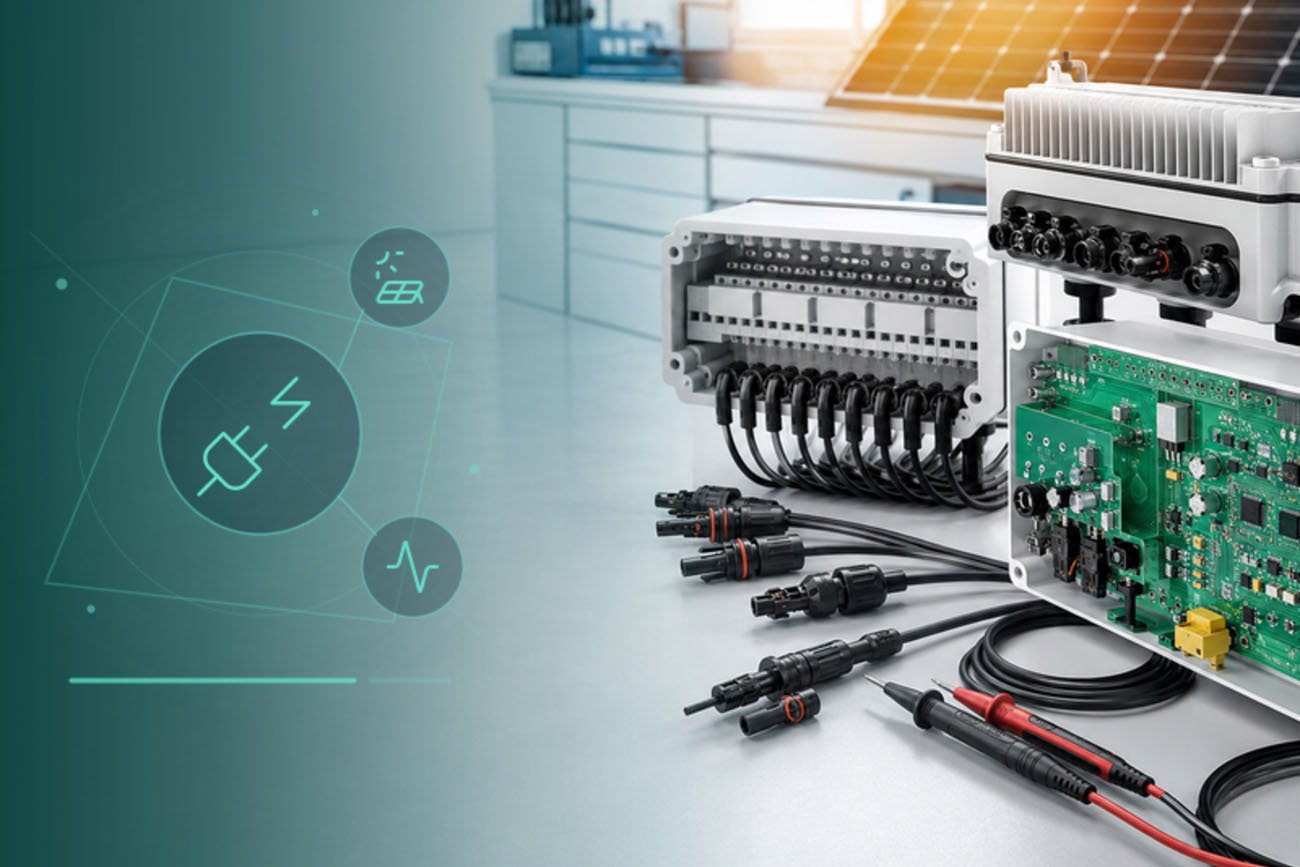
The reliability of a photovoltaic installation depends on more than the module. Inverters, optimizers, combiner boxes, connectors, sensors and control electronics operate outdoors or in partially conditioned spaces while handling substantial electrical and thermal load.
Environmental validation helps identify seal leakage, connector instability, insulation degradation, thermal derating and control faults before equipment is deployed at scale.
Start with installation conditions
Define whether the product is installed outdoors, beneath modules, inside a cabinet or in an equipment room. Consider solar heating, cold starts, daily cycling, humidity, condensation, dust or water exposure, and self-heating under load. Environmental chambers address temperature and humidity; separate methods may be needed for solar radiation, ingress or corrosion.
The test plan should combine those methods logically without assuming that one chamber exposure represents every field stress.
Test powered behavior
Power electronics often need to operate during environmental exposure. Apply a representative electrical load and monitor conversion efficiency, current, voltage, internal temperatures, fan behavior, derating and fault codes. Provide the chamber supplier with maximum heat dissipation so cooling capacity can be evaluated.
Cable feedthroughs should support high current without creating uncontrolled air leakage or mechanical strain. External loads and data systems are generally easier to service outside the chamber.
Investigate connectors and seals
Temperature cycling can change contact pressure and stress dissimilar materials. Humidity can reveal corrosion or insulation weaknesses. Condensation testing may be appropriate when a cold product can encounter warm humid air, but the dew-point event must be deliberately controlled.
For connectors, track contact resistance before, during or after exposure as required. For sealed enclosures, inspect gaskets, cable glands, pressure equalization features and water pathways.
Select equipment for the installed load
Small optimizers and connectors may fit efficiently in a benchtop or reach-in chamber. Large inverters, cabinets or multiple units may need a walk-in system. In every case, consider airflow, heat load, fixture spacing, access and instrumentation.
Rapid-change systems can reduce cycle time or reproduce steep transitions, but verify the rate at the specimen. High-mass inverters will not follow air temperature instantly.
Integrate standards and field evidence
PV module qualification is commonly based on the IEC 61215 series, while inverters and balance-of-system components may follow separate IEC, regional or customer specifications. Field-return data should also inform the test plan. If failures cluster around a particular connector, climate or operating state, reproduce that mechanism in a controlled profile.
SCICOOLING offers temperature-humidity, rapid-change and walk-in systems with power feedthroughs and monitoring options for renewable-energy electronics. The most useful validation combines environmental control with realistic electrical operation and evidence tied to field risk.
Editorial note: Confirm the contractual standard edition, test severity, acceptance criteria and final internal URLs before publication.