
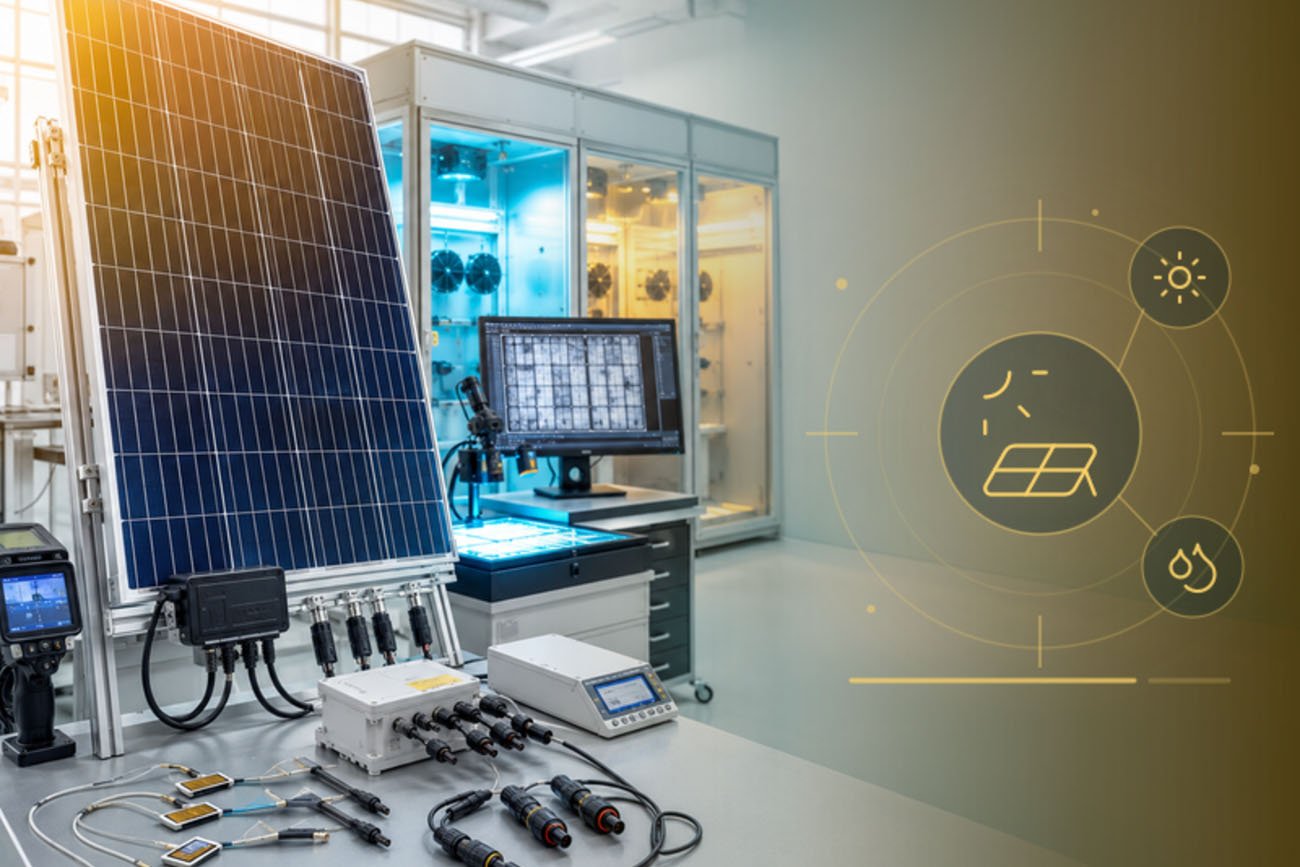
Photovoltaic modules are expected to operate outdoors for decades while exposed to heat, cold, moisture and repeated daily temperature changes. Environmental qualification compresses selected stresses into controlled laboratory sequences so manufacturers can evaluate design durability before long-term field evidence is available.
Two of the most important exposures are damp heat and thermal cycling. They target different mechanisms and require careful control of module loading, sensor placement and chamber performance.
What damp heat evaluates
Long-duration high temperature and humidity can challenge encapsulants, backsheets, edge seals, junction boxes, connectors and adhesion interfaces. Moisture can contribute to corrosion, insulation change, delamination and material degradation.
The chamber must maintain stable temperature and humidity around large surfaces for an extended period. Airflow should not be blocked by tightly packed modules, and condensation should be avoided unless the applicable method specifies it.
What thermal cycling evaluates
Repeated high-to-low transitions create expansion and contraction across glass, cells, ribbons, encapsulants, frames and electrical connections. Cycling can reveal solder fatigue, interconnect damage, cracked cells, seal stress and loss of electrical continuity.
Module temperature may lag behind chamber air. Attach calibrated sensors to representative locations and follow the dwell rule specified by the test method. Loading density and rack design should remain consistent across batches.
Engineer the chamber around full-size modules
PV testing often requires a walk-in or large reach-in system. Key design points include:
- Door and workspace dimensions for the largest module.
- Rack geometry, orientation and safe handling.
- Floor load and service access.
- Airflow clearance between specimens.
- Number and routing of electrical measurement cables.
- Humidity water quality and long-duration reliability.
- Recovery after door opening and specimen loading.
For bifacial or flexible modules, fixtures should support the product without introducing unintended mechanical stress.
Plan measurements before exposure
Environmental conditioning is normally part of a broader qualification sequence. Record baseline electrical performance and visual condition, then repeat the specified measurements after exposure. When required, monitor insulation or continuity during the test.
Chamber data should include temperature, humidity, alarms and interruptions. Long tests need remote visibility, protected program recovery and clear procedures for utility outages.
Work from the current test procedure
IEC 61215-2:2021 defines test procedures for design qualification and type approval of terrestrial photovoltaic modules, including methods intended to demonstrate resistance to prolonged outdoor exposure. The series includes requirements for different module technologies, and other standards may apply to safety or specific components.
SCICOOLING configures temperature-humidity and walk-in systems for full-size modules, components and renewable-energy assemblies. Reliable PV testing requires more than a large room: it needs verified uniformity, durable humidity control, stable racks and traceable long-duration operation.
Editorial note: Confirm the contractual standard edition, test severity, acceptance criteria and final internal URLs before publication.