
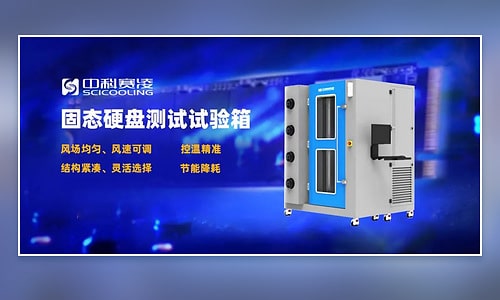
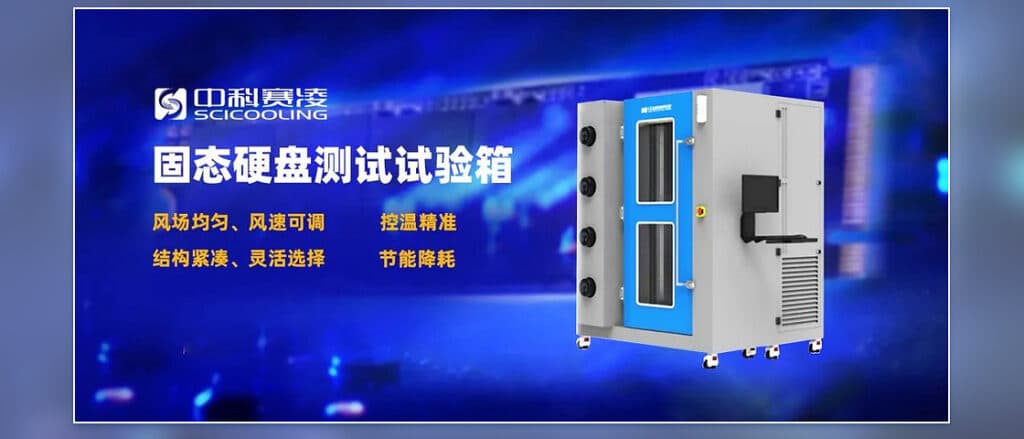
Recently, SCICOOLING (Beijing) Technology Co., Ltd. has been in deep cooperation with a well-known domestic enterprise-level SSD manufacturer. Through technical breakthroughs by a scientific research team, they successfully developed a test chamber specifically designed for solid-state drive reliability testing, which has already been delivered to users and received positive reviews.
Before SSDs are launched, they need to undergo tests such as aging and high and low temperature tests, with special requirements for temperature control and wind speed. It is reported that although there is no shortage of SSD testing products on the market, they generally suffer from drawbacks such as uneven wind speed distribution, poor temperature uniformity, high energy consumption, and low testing efficiency. To address the pain points of existing products on the market, the SCICOOLING research team has carefully optimized the structural layout, refrigeration system, and control system of the test chamber, achieving excellent results in wind speed, temperature consistency, and energy savings.
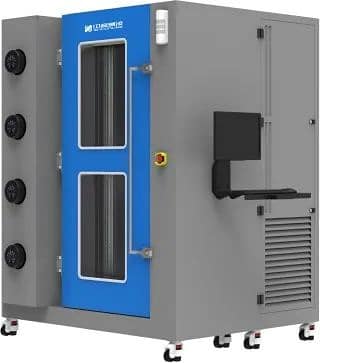
Schematic diagram of the SSD test chamber appearance
1 The wind field is uniform and the wind speed is adjustable
The drawbacks of traditional SSD test chambers include: First, the air duct width is relatively large, preventing air from concentrating through the test piece and affecting wind speed, resulting in wind speed uniformity that cannot meet the high performance requirements. Second, the air outlet is too close to the specimen, making it impossible to ensure temperature uniformity at high wind speeds. Third, due to limitations in the size of the motor and impeller, the inner box is quite deep, the air outlets are distributed laterally, and the duct width is much greater than the space required for the test piece, so the air cannot be concentrated onto the specimen, resulting in energy waste—that is, fewer test specimens, and less energy efficiency. Based on these issues, the SCICOOLING research team designed various optimized air duct structures, selected the optimal scheme through professional CFD simulation comparison, and finalized the final scheme after actual assembly verification and multiple optimization adjustments. Actual measurements show that under full load, the surface wind speed of each SSD is not less than 7m/s, the wind speed difference in the same column is less than 1m/s, and the same row is less than 4m/s, resulting in better wind speed consistency.
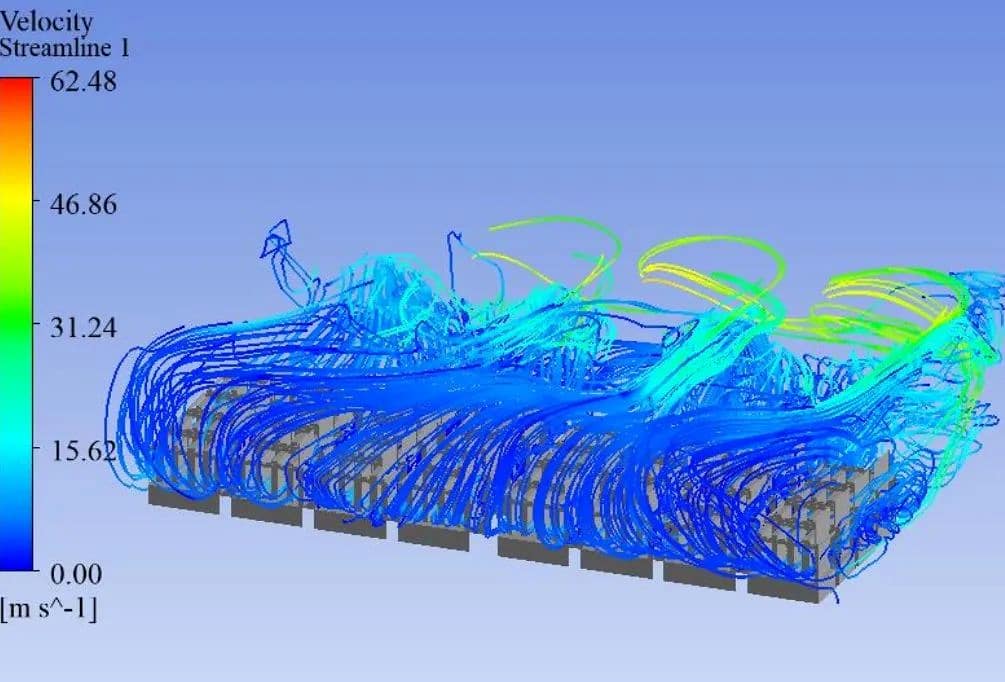
Wind farm CFD simulation results
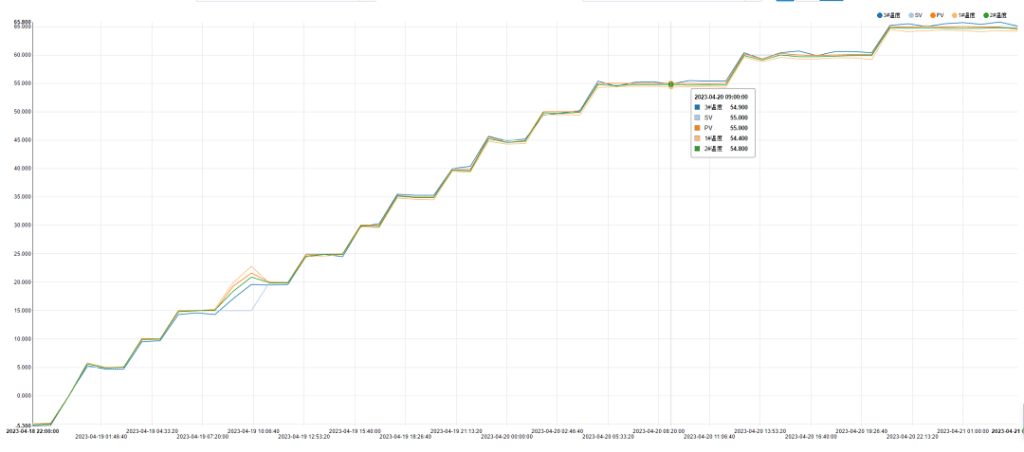
SSD test chamber temperature operation curve
2 Precise temperature control
This product uses temperature control technology without temperature difference for specimens, with multiple sensors designed to be installed at the specimen location for direct temperature control. Using the latest PID algorithm intelligent temperature control program, it achieves rapid and stable specimen temperature with minimal temperature fluctuations.
3 Energy saving and consumption reduction
Adopts an intelligent stepless adjustment refrigeration system that automatically matches cooling output based on load heat, achieving full-range automatic adjustment from 0~100%. Compared to temperature-cooling balance control technology, it can save over 40% of electricity consumption.
4 Compact structure and flexible selection
This product adopts SCICOOLING’s unique single-compressor refrigeration technology, which offers a more compact overall structure compared to traditional stacked refrigeration products, significantly saving space in space. Depending on site conditions, either integrated or split structures can be selected. Split structures are suitable for refrigeration units placed outdoors, avoiding the impact of heat emissions and noise from the refrigeration system on the indoor environment.
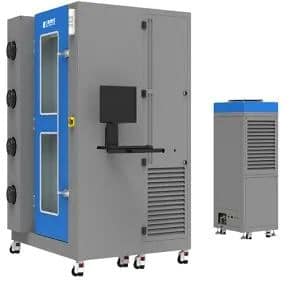
Schematic diagram of the split structure

SCICOOLING continues to dedicate itself to the exploration and research of environmental test equipment, insists on technological innovation, and strives to create a vast ocean in the field of environmental test equipment.
Related Resources & Next Step
Suggested internal links: Products > Environmental Test Chambers | Contact > Submit a Project Request
Need to evaluate a test profile or configure a chamber? Explore the relevant SCICOOLING solution and submit your project requirements.